









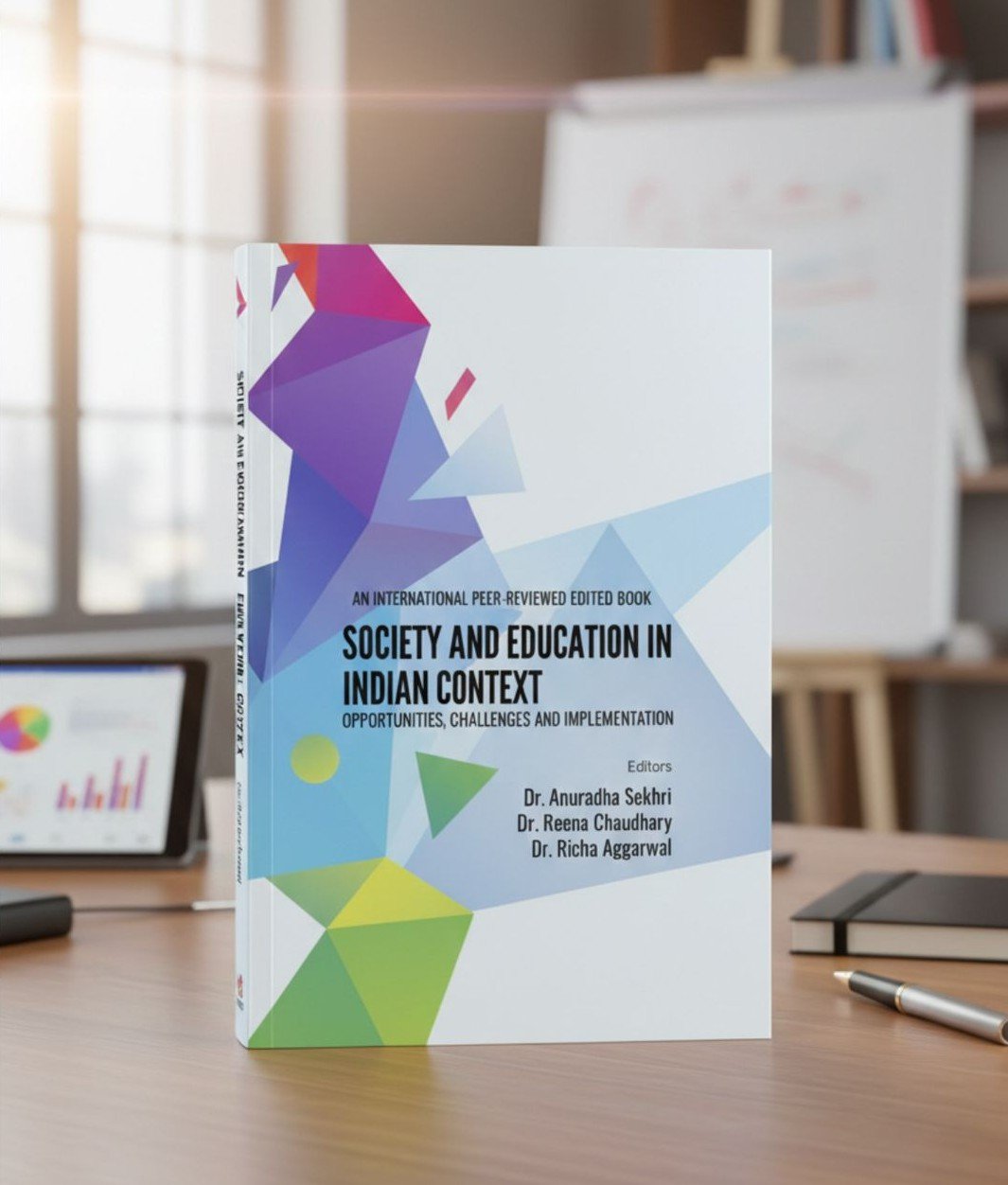
At a times when education systems across the world are being reshaped by rapid technological change, shifting labour markets, post-pandemic realities, and renewed global attention to equity and sustainability, scholarly engagement with education has assumed unprecedented importance. In India, the National Education Policy (NEP) 2020 represents a defining moment in this transition, calling for research that is multidisciplinary, context-sensitive, and responsive to contemporary social challenges. The theme of Society and Education in Indian Context: Opportunities, Challenges and Implementation is therefore both timely and innovative, as it moves beyond narrow institutional or policy analysis to examine education as a deeply social, cultural, and ethical enterprise within the twenty-first-century knowledge society.
The relevance of this theme lies in its recognition that educational reform cannot be understood or implemented in isolation from social realities. By foregrounding the reciprocal relationship between education and society, the book addresses questions that are central to contemporary educational discourse: how education responds to social diversity and inequality; how technological and policy reforms reshape learning experiences; and how institutions negotiate the tension between economic imperatives and social responsibility. This integrated approach makes the theme particularly significant for researchers, as it aligns closely with the priorities articulated in NEP 2020—holistic development, inclusivity, ethical citizenship, sustainability, and contextual relevance—while also engaging with global debates on education in the twenty-first century.
The innovative character of the book lies in its ability to bring together diverse strands of inquiry within a single conceptual framework. Rather than treating issues such as gender, marginalization, employability, digital learning, tradition, and ethics as isolated concerns, the volume weaves them into a coherent sociological narrative. This interdisciplinarity reflects a shift in contemporary education research, which increasingly recognizes that complex educational challenges require integrated and socially grounded perspectives. For researchers, the book thus serves not only as a source of empirical insight but also as a model for analytically linking policy, practice, and social context.
Education in India has always been more than a formal system of schooling. It has functioned as a social institution through which knowledge is transmitted, identities are shaped, hierarchies are negotiated, and visions of the future are imagined. The volume engages with this deeper role of education by situating it within India’s historical experiences, cultural diversity, and evolving socio-economic landscape. It demonstrates how education simultaneously reflects existing social structures and holds the potential to transform them, making it a critical site for understanding social change in contemporary India.
A major contribution of the book lies in its sustained focus on equity and inclusion. Despite significant expansion in educational access, structural inequalities related to caste, class, gender, and region continue to shape educational trajectories. By grounding its analysis in empirical evidence and lived experiences, the book makes visible the persistent gaps that challenge the promise of equal opportunity. At the same time, it highlights pathways through which education can act as an instrument of empowerment and social mobility, particularly for historically marginalized groups.
Gender analysis occupies a central place in the volume, offering both critique and possibility. The book examines how curricula, textbooks, and classroom practices often reproduce gender norms, while also documenting emerging shifts in female participation, leadership, and agency. These discussions underscore the importance of education as a space where social norms are contested and renegotiated, reinforcing the book’s relevance to contemporary debates on gender justice.
The volume also engages critically with higher education and employability, addressing one of the most pressing concerns of the twenty-first-century education system. It interrogates the gap between academic learning and labour market demands, while situating current reforms within the broader vision of NEP 2020. By combining policy analysis with sociological insight, the book offers a nuanced understanding of both the promise and the challenges of educational reform.
Further innovation is evident in the book’s dialogue between tradition and modernity. By revisiting the Gurukul system alongside discussions of digital learning and artificial intelligence, the volume creates a meaningful conversation between indigenous educational philosophies and contemporary pedagogical developments. This synthesis reflects a growing recognition that future-oriented education must draw from both cultural heritage and technological innovation.
Underlying all these discussions is a strong ethical orientation. The book emphasizes that education in the twenty-first century must cultivate not only skills and knowledge but also values such as social responsibility, sustainability, and civic engagement. In doing so, it reinforces the idea that education is central to the moral and social fabric of society.
Taken together, Society and Education in Indian Context: Opportunities, Challenges and Implementation presents a theme that is deeply relevant, intellectually significant, and conceptually innovative. By integrating theory, empirical research, and policy analysis within a sociological framework, the book offers researchers, educators, and policymakers a comprehensive lens through which to understand and engage with the evolving relationship between education and society in contemporary India.